Business
Tesla Slashes Model Y Prices in Europe Amidst EV Demand Uncertainty
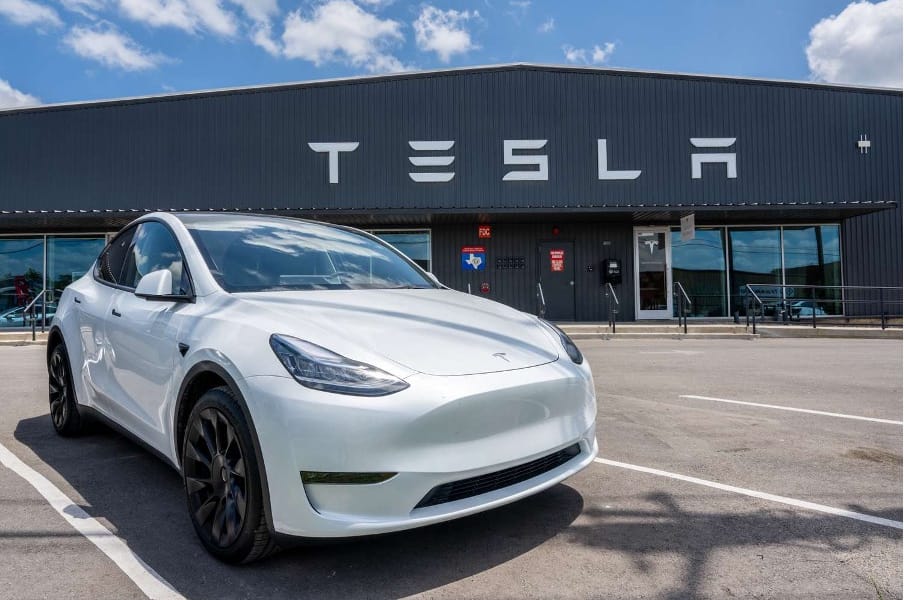
In response to a shifting electric vehicle (EV) landscape, Tesla has implemented significant price cuts for its Model Y cars across Europe, including Germany. The move comes amid a broader trend of slowing EV demand, influenced by a reduction in state subsidies and increased borrowing costs, prompting buyers to reconsider major purchases. Last week, Tesla had already reduced prices in China, highlighting the company’s proactive approach to navigating uncertain market conditions.
The price adjustments contributed to a downward trend in Tesla’s shares, leading to a nearly 3% decline. This adds to the challenges Tesla has faced in the stock market in 2024, with lower price targets from notable brokerages UBS and Wells Fargo. The impact was not limited to Tesla, as Germany-listed rivals such as Mercedes Benz Group, Volkswagen, and Bayerische Motoren Werke also experienced declines ranging from 2.3% to 3.3%. In the United States, Ford Motor and General Motors saw their shares drop by 2% and 1.1%, respectively.
In Germany, Tesla’s price reductions for the Model Y Long Range and Model Y Performance were substantial, amounting to 5,000 euros each. This brought their prices down to 49,990 euros and 55,990 euros, representing discounts of 9% and 8.1%, respectively, compared to their previous prices. Additionally, the price of Model Y rear-wheel drive models saw a 4.2% reduction. Similar adjustments were made in other European countries, with reductions of up to 6.7% in France, up to 10.8% in Denmark, up to 7.7% in the Netherlands, and between 5.6% and 7.1% in Norway.
While Tesla has not officially disclosed the reasons behind the price cuts, it aligns with the broader context of slowing EV demand. The deduction in state subsidies and higher borrowing costs have led consumers to reevaluate their purchasing decisions, impacting the entire electric vehicle market. In 2023, Tesla faced challenges in Germany, witnessing a 9% decline in new registrations to 63,685 vehicles. This contrasted with an 11.4% increase in EV sales in Germany, making Volkswagen the largest seller of EVs in the country.
Wells Fargo and UBS responded to the challenging market conditions by reducing their price targets on Tesla’s stock by more than 8% and nearly 11%, respectively. The stock had already experienced an 11.5% decline in January alone. These adjustments highlight the volatility in the EV sector and the challenges faced by industry leaders like Tesla.
The recent price cuts also follow Tesla’s announcement of suspending most of its car production at its factory near Berlin from January 29 to February 11. The company attributed this move to a lack of components resulting from changes in transport routes due to attacks on vessels in the Red Sea. These disruptions further contribute to Tesla’s efforts to adapt to a dynamic global supply chain.
In the broader context, the EV subsidy program in Germany, originally intended to continue until the end of 2024, concluded prematurely last month. This decision is expected to impact German automakers, who are already striving to match the competitive prices offered by Chinese and U.S. competitors. Tesla’s strategic price adjustments reflect its agility in responding to market uncertainties and position it to navigate challenges while sustaining its market presence.