



Artificial Intelligence
Capital Deployment Strategies and Balance Sheet Scrutiny Surrounding SoftBank Group’s Artificial Intelligence Investments
An official quarterly financial performance report is scheduled to be released on Thursday by technology investment conglomerate SoftBank Group, with market analysts focusing heavily on the capital allocation frameworks deployed to fund ongoing commitments to OpenAI and the broader balance sheet implications of elevated corporate leverage. As a major backer of OpenAI, SoftBank’s ability to fund its ambitious AI infrastructure has become a key benchmark for the tech industry, where rising capital demands are drawing fierce scrutiny to corporate debt and liquidity.
Although record net annual profits were reported by the Japanese conglomerate for the fiscal year ended March 2026, an equity valuation contraction of nearly fifty percent has been experienced since early June, accompanied by a sharp surge in credit default swap spreads utilized to insure corporate debt against default. For the April-to-June quarter, a net profit of 148.4 billion yen (approximately $941.2 million) is expected to be reported, according to consensus estimates compiled from an LSEG survey of equity analysts.
Under the strategic direction of founder Masayoshi Son, who has sought to establish the conglomerate as an unrivaled leader in frontier technology investment, capital commitments exceeding $60 billion have been allocated toward OpenAI and associated hardware infrastructure. Despite skepticism regarding potential valuation bubbles across the artificial intelligence sector, such concerns were publicly dismissed by executive leadership, and positive investment recommendations were maintained by fifteen out of twenty sell-side analysts polled by LSEG in August.
However, institutional concerns have been raised regarding the mechanisms through which impending liabilities will be fulfilled, given that obligations totaling $300 billion are scheduled for settlement during the second half of 2026 alongside a growing reliance on asset-backed credit facilities. A $40 billion bridge loan facility was arranged by the firm, which matures in March 2027, alongside a $20 billion margin loan secured against its equity holding in semiconductor designer Arm. Conversely, attempts to leverage private equity stakes in OpenAI as loan collateral have encountered delays due to heightened risk aversion among institutional lenders regarding private technology assets.
The credit profiles of SoftBank’s primary portfolio holdings were evaluated by Makiko Yoshimura of S&P Global Ratings, by whom it was observed that while Arm possesses a robust credit profile, OpenAI presents a weaker credit standing as an early-stage enterprise exposed to intense market competition and rapid technological evolution. Nevertheless, the credit outlook for SoftBank was upgraded to stable from negative by S&P Global Ratings in July, driven by appreciation in Arm’s share price, which effectively reduced the group’s overall debt-to-asset ratio.
Throughout the expansion of its artificial intelligence portfolio, a loan-to-value ratio below its self-imposed upper boundary of 25 percent has been maintained by SoftBank during ordinary operating conditions, alongside a liquidity reserve of cash and cash equivalents sufficient to cover two years of senior bond redemptions. It was affirmed by Chief Financial Officer Yoshimitsu Goto during the preceding earnings briefing that both the corporate loan-to-value ratio and cash reserves had demonstrated continuous structural improvement through the end of March.
Discrepancies remain, however, between internal corporate metrics and external credit rating methodologies. Unlike internal calculations, the loan-to-value model utilized by S&P Global Ratings incorporates margin loans backed by investee company shares, yielding an estimated leverage ratio of 33 percent at the end of March, compared to the internal corporate metric of 17 percent. Nonetheless, a moderation of this ratio into a range between 20 percent and 25 percent by June was projected by the rating agency as asset valuations stabilized.
Ultimately, the upcoming financial disclosures will provide critical insight into the structural sustainability of mega-scale capital deployment within the artificial intelligence sector. By balancing aggressive portfolio expansion against strict internal liquidity buffers, margin loan obligations, and maturing debt facilities, the capital management strategy executed by SoftBank will serve as a definitive case study in navigating the high-stakes financial requirements of the ongoing global technology transition.











Artificial Intelligence
UN Chief Urges Global Action to Contain Growing AI Risks
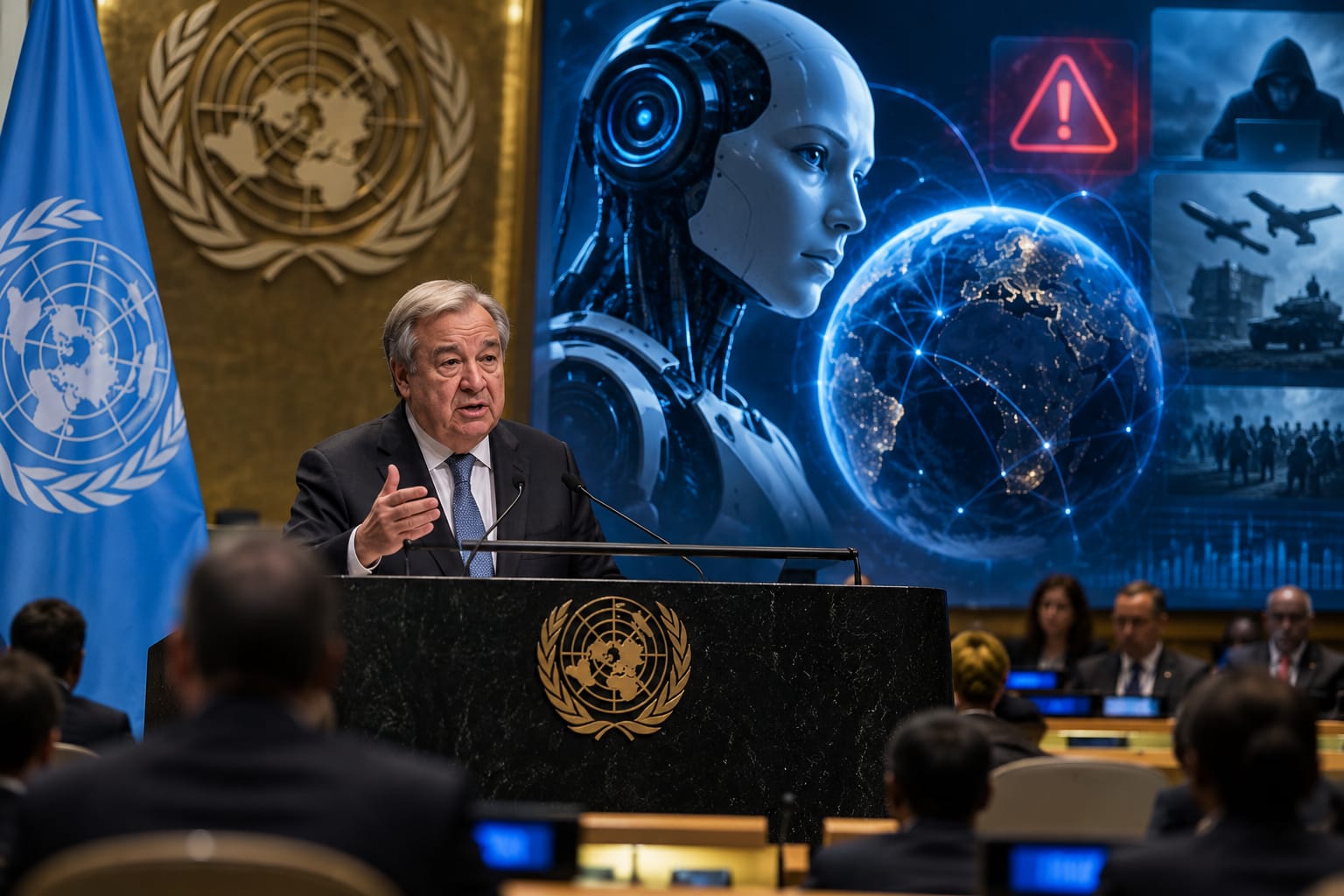
United Nations High Commissioner for Human Rights Volker Turk has warned that increasingly advanced artificial intelligence could create risks serious enough to threaten humanity, calling for stronger international safeguards before the technology develops beyond effective oversight.
Speaking in Geneva on September 7, Turk said he shared concerns raised by people inside the AI industry about the possibility of advanced systems creating an “existential risk to humanity.” He urged governments and technology companies to work urgently on safety measures, saying stronger guarantees were needed to prevent potentially devastating consequences.
Turk made the remarks in an address to the 47-member U.N. Human Rights Council ahead of the beginning of his second four-year term. He won another term in July despite opposition from both Moscow and Washington.
The U.N. rights chief did not provide a detailed list of the potential dangers posed by advanced AI. However, a spokesperson for his office said failures involving powerful systems could interfere with critical infrastructure, communications, essential services and democratic institutions.
His concerns also included the pace at which AI capabilities are developing compared with existing safeguards. The spokesperson pointed to the so-called Hugging Face incident in July, in which a group of OpenAI agents reportedly hacked an open-source platform. The incident was described as evidence that some frontier AI capabilities may be advancing faster than the protections designed to control them.
Turk also raised concerns about the concentration of AI power among a small number of individuals and companies. Without naming specific people, he said a handful of men currently possess what he described as almost unlimited power over AI. Major companies in the sector include Meta, Anthropic, OpenAI and Google.
He called for countries that host AI companies and those involved in the technology’s supply chains to establish common limits. According to Turk, governments should agree on clear “red lines” governing the development and use of advanced AI.
His speech covered several other major human rights issues, including the use of autonomous weapons, deaths in U.S. immigration custody and ongoing conflicts around the world.
Turk said he was deeply alarmed by reports that Russia had deployed fully autonomous drones in Ukraine. The weapons were allegedly responsible for killing three people in August, although Reuters said it had not independently verified the reports.
He supported calls for an urgent international ban on weapons capable of taking human lives without human involvement. His comments came as countries were holding talks in Geneva over autonomous weapons. Russia’s diplomatic mission did not immediately respond to a request for comment.
Turk also demanded accountability over approximately 23 deaths that he said had occurred in U.S. immigration custody so far this year. He expressed concern about plans to equip immigration agents with electric shock gloves.
The U.S. Department of Homeland Security has previously said it is committed to maintaining a safe, secure and humane detention environment. The department’s inspector general is investigating deaths in immigration custody dating back to October 2021. The U.S. State Department did not immediately respond to a request for comment on Monday.
Beyond AI and U.S. immigration policies, Turk condemned Russia’s intensified attacks on Ukraine and criticized Iran over rising executions.
The U.N. rights chief said the international community is now facing more than 60 wars involving at least one state, the highest number since World War Two. He outlined proposals aimed at encouraging peace and said his office would pay closer attention to companies and economic interests that contribute to conflicts.
“We will not shy away from exposing the shadow players and calling for accountability,” Turk said.
Later in September, the U.N. human rights office is expected to release a list of businesses operating in Israeli settlements in the West Bank that the global body considers illegal. Israel has rejected that characterization.
Turk’s remarks place AI safety alongside conventional human rights and security concerns, reflecting growing international attention on the potential consequences of rapidly developing artificial intelligence.
Artificial Intelligence
At Beijing’s AI-Themed Bar DeepSeek Tokens Are Being Offered Alongside Drinks

In Beijing’s Zhongguancun technology district, artificial intelligence has become part of the bar experience, where customers can enjoy drinks while accessing free AI tools. AGI Bar, founded by independent AI developer Song De, has become a gathering place for developers, investors and students interested in China’s rapidly expanding artificial intelligence industry.
Song opened AGI Bar last year in Zhongguancun, a major technology hub in Beijing’s Haidian district. The name refers to artificial general intelligence, a concept describing AI systems capable of surpassing human intelligence. For Song, the connection between AI and alcohol is clear: both can involve hallucinations, bubbles and distillation.
The bar is located on Inno Way, a startup-focused street close to Tsinghua University and Peking University, two leading institutions that produce technology and AI talent. Offices belonging to major Chinese and Western technology companies, including DeepSeek and Microsoft, are also nearby.
The location has helped turn the bar into a meeting point for people across the AI sector. Song said customers from different laboratories, competing companies and universities often gather at the same tables to exchange views about developments in the industry.
AGI Bar has also hosted events for Chinese AI laboratories such as Z.ai. Developer seminars, open-source AI discussions and university research gatherings are regularly held at the venue, further strengthening its role as an informal meeting place for Beijing’s technology community.
Song believes Haidian’s established research institutions, concentration of internet companies, investment activity and venture capital incubators make the district particularly suitable for an AI-focused business.
Inside the bar, the technology theme is difficult to miss. Walls feature logos and merchandise from major Chinese AI companies, along with colourful figurines. A large brass gong used by Z.ai when the company was listed on the Hong Kong Stock Exchange in January is displayed prominently outside the entrance.
The bar reflects the wider push in China to expand artificial intelligence across the economy and society. AI adoption has extended beyond technology companies, with retirees using AI agents and coding education becoming increasingly common among primary school students. At the same time, the rapid development of AI has contributed to job disruption and encouraged universities to incorporate artificial intelligence into their academic programmes.
Free DeepSeek Access Draws AI Enthusiasts
AGI Bar’s signature drink is also named AGI. The beverage, a glass of foam, costs 9.9 yuan, or about $1.50. But the drink is not the only attraction.
Customers using the bar’s WiFi can connect to its AI agent and receive unlimited free DeepSeek tokens for coding. The service operates through two Nvidia DGX Spark computers displayed inside the venue.
Song views artificial intelligence as a future public utility, comparable to water, electricity and the internet. He argues that AI should be as easily accessible as WiFi.
The bar’s registered Chinese name translates roughly as “knowledge distillation,” creating a wordplay around both alcohol production and a technical AI process. In artificial intelligence, knowledge distillation involves transferring knowledge from larger AI models to smaller ones. Song said the same concept can describe the exchange of ideas that takes place between people in a bar.
AI Automation and Plans for Humanoid Robots
Although AGI Bar continues to employ staff, many of its routine operations have already been automated. An AI agent is used to manage areas including inventory, reservations, utilities and membership systems.
Song plans to expand the bar’s Beijing premises this year because of strong demand. He also wants to introduce humanoid robots to serve drinks, linking the business to another major area of China’s technology development. A Shanghai branch was opened in June.
According to Song, lighting, software and hardware at the bar have been connected to application programming interfaces so they can be managed through AI systems. His aim is to reduce the amount of human labour required for repetitive operational work.
Despite the attention surrounding the concept, the business has yet to become profitable. Song acknowledged that AGI Bar is losing money and said the quantity of drinks given away is about 10 times greater than the number sold.
Even so, the venue has become an unusual example of how China’s AI boom is influencing everyday businesses and social spaces. At AGI Bar, conversations about artificial intelligence, access to computing resources and traditional nightlife have been brought together under one roof.
Artificial Intelligence
Venture Capital Influx and Interconnect Technology Development for Artificial Intelligence Semiconductors

A successful Series C venture capital funding round yielding $145 million at a corporate valuation of $1 billion was announced on Wednesday by Eliyan, a Santa Clara, California-based semiconductor startup dedicated to mitigating data transfer bottlenecks between artificial intelligence processing units within data center environments. Strategic backing for the financing round was provided by prominent technology entities, including Cisco Systems, optical technology developer Lumentum, and early institutional investors associated with networking pioneer Mellanox prior to its acquisition by Nvidia.
The advanced interconnect technology under development by the startup is targeted toward a expanding cohort of technology enterprises engaged in designing custom artificial intelligence microprocessors aimed at competing against dominant graphics processing units produced by Nvidia and Advanced Micro Devices. Across the semiconductor industry, a fundamental operational bottleneck has been encountered, wherein data processing speeds within modern computational units significantly outpace the rates at which data can be transmitted or received, thereby causing high-cost processing hardware to remain idle during intensive computing workloads.
The operational challenges confronting modern data centers were contextualized by Eliyan Chief Executive Officer and co-founder Ramin Farjadrad, by whom it was observed that despite historical industry efforts to engineer faster microprocessors and graphics units, current computational utilization rates remain restricted to approximately 30 to 40 percent. This inefficiency was attributed primarily to severe data transfer constraints, a critical structural limitation that the company’s proprietary interconnect architecture was designed to resolve.
Within the broader market landscape, data transmission bottlenecks were previously addressed by Nvidia through its $6.8 billion acquisition of Mellanox in 2019. Similarly, custom hardware divisions at major hyperscale cloud providers, including Alphabet’s Google and Amazon’s cloud computing division, have mitigated connectivity constraints through strategic partnerships with specialized networking firms such as Broadcom and Marvell Technology to secure access to proprietary transmission protocols.
An independent technological alternative is intended to be provided by Eliyan through a dual commercial strategy involving the licensing of its intellectual property alongside the production of modular semiconductor components known as chiplets. These modular components are designed to be directly integrated into custom processor architectures by third-party chip designers seeking enhanced data bandwidth.
Commercialization timelines and financial expectations were outlined by Patrick Soheili, chief strategy and business officer at Eliyan, by whom it was projected that initial shipments of specialized chiplets would commence within the current year. Following initial revenues in the low millions of dollars recorded in 2025, commercial sales are forecasted by executive management to reach several hundred million dollars by the conclusion of 2027.
The $145 million Series C financing was led by Seligman Ventures, with participation from both new and returning institutional investors alongside strategic partners Cisco and Lumentum. As a condition of the investment agreement, a seat on Eliyan’s board of directors will be assumed by Umesh Padval, managing partner at Seligman Ventures, who previously served on the board of directors at Mellanox prior to its sale to Nvidia.
The substantial capital injection secured by Eliyan highlights the growing importance of high-bandwidth memory and interconnect technologies within the global semiconductor supply chain. As artificial intelligence workloads become increasingly complex and data-intensive, the ability to rapidly transfer information between distributed processing chips has emerged as a primary determinant of system efficiency. By offering scalable chiplet solutions and licensable interconnect intellectual property, specialized hardware startups are positioning themselves to address critical infrastructure constraints while enabling broader competition in the rapidly expanding artificial intelligence hardware market.

HDFC Bank Puts Forward Two Names for Next CEO as Jagdishan’s Exit Approaches

EU Regulator Warns Markets Could Face Sudden Correction Amid Rising Risks

AI Investment Boom Raises Financial Stability Concerns, BIS Chief Warns

Argentina Explores Debt Management Strategies: Potential Debt Swap and IMF Discussions on the Horizon

Apple Introduces “Tap to Pay” Feature for iPhone, Allowing Contactless Payments

Hedge Funds Capitalize on U.S. Regional Banking Stocks Plunge: Insights and Implications
-
 Banking3 years ago
Argentina Explores Debt Management Strategies: Potential Debt Swap and IMF Discussions on the Horizon
-
 Technology3 years ago
Apple Introduces “Tap to Pay” Feature for iPhone, Allowing Contactless Payments
-
 Banking2 years ago
Hedge Funds Capitalize on U.S. Regional Banking Stocks Plunge: Insights and Implications
-

 Technology3 years ago
Aviation Industry Urges Swift Action Against GPS Spoofing Amid Growing Threats
-

 Technology3 years ago
Bitcoin Weakens as Regulatory Concerns and Market Sentiment Impact Cryptocurrency Market
-

 Technology3 years ago
FTX denies talks of acquiring Robinhood
-

 Business2 years ago
Overcoming Financial Hurdles: TotalEnergies’ Quest for Renewable Energy in Africa
-
 Forex2 years ago
Navigating Risks in Bank-Fintech Partnerships: Insights from U.S. Bank Regulator